As I was writing this entry last week I fell asleep on my keyboard. Total failure! Now let's try again :)
So I have just completed two weeks with my new class, the Mechatronics '11. People there are all very friendly and I don't feel alienated at all. I'm even going to karaoke with some of my new classmates tomorrow!
Although I am now officially in 4th year, I am joining the 3rd year Mechatronics class for the spring term... and I get quite a few confused looks because of this. Actually, the reason why I'm joining a younger class is because I am making up for some courses that I have missed while being on exchange.
Since all students of the same class from Waterloo engineering usually share the same schedule, many complain that Waterloo's system is not flexible, when in fact that's not true at all. I have found that the class schedules are more of a "recommendation" than anything, and if you have good reasons to deviate from it, the academic advisors are more than willing to accomodate you. In fact, when I proposed my plan for a change of study stream and a second exchange to my program director, I was actually surprised as how easily it had gotten approved. I've found that as long as you have done your research, know exactly what you're doing and can find valid arguments as to why your plans should be approved, the advisors are usually very reasonable and gives you a lot of freedom with your classes. I know people who have switched study streams, taking double majors, taken two one-year work terms, extended their degree for a year for no big reason, etc. so I guess it's not uncommon to change your course plan in Waterloo at all.
The next thing I want to blog about, now, is the sacrifices you have to make to go on exchanges and such. I don't want to talk purely about one side of things, or to rave about all the good things of exchanges without mentioning the bad side.
First, going on exchange requires a lot of planning, paperwork and meetings with advisors. You have to be on top of your own things, choose your courses wisely, get them approved, prepare back-up plans, etc. both before and after the exchange. You cannot sit on your bum and expect your advisors to tell you everything you need to know; you'll have to do your own research, and schedule meetings with profs yourself. I have a friend who didn't consult his advisor after his exchange, and ended up having to stay for an extra term to make up a course he did not get credited for. It's a lot of work and it gobbles up a lot of time, but you'll know it's worth it once you step on your plane.
Then there's the course plan issue. Many students have messaged me about going on exchanges and many of them have been scared off because of the course matching problems I've had (4 out of my 5 courses couldn't get transferred). Having to make up for courses is not an uncommon issue for exchange students, but since courses taken abroad can be counted as "technical electives", most don't have to lengthen their degree and have no problem graduating in time. Sure, right now I am giving up my last work term because of my exchanges, but considering that I am doing TWO exchanges plus a minor in psychology (which requires 10 extra courses) and STILL graduating in time, it's really more than worth it. Plus, now I get to join other classes and meet new friends!
So the bottom line is, no pain no gain... Lame, I know, but it's so true! Going abroad and exploring a new country with friends from all over the world is an amazing experience, but if you're gonna have to work for it to deserve it! ;)
Showing posts with label University of Waterloo. Show all posts
Showing posts with label University of Waterloo. Show all posts
Sunday, May 17, 2009


Wednesday, May 6, 2009
MSci 452: Decision Making Under Uncertainty
The most interesting and enjoyable course that I have taken as part of my Management Sciences option has to be MSci 452: Decision Making Under Uncertainty. The course deals with different approaches to decision making process by looking at factors (for example biases) that exist when we are making decisions under uncertainty. Last spring term, when I took the course, it was taught by Professor Scott Jeffrey who clearly enjoys teaching the course material and always has some great advice to share!
In addition to learning a great deal about the mistakes that are made when we make decisions, the course also focuses on how to improve this process. At the end of the term, we were also able to do negotiations, and I believe I speak for the majority of the class when I say that was the most enjoyable part of the course. During the various negotiations, we were partnered up and had to negotiate based on case studies, using what we had learned during the course. We had to negotiate deals for things like buying a car, selling an antique set, and getting funding for a project. This was a fun way to put in use the course material and interact with our classmates.
This spring, if you are looking for a course where you can learn a lot while having lots of fun, take MSci 452!
In addition to learning a great deal about the mistakes that are made when we make decisions, the course also focuses on how to improve this process. At the end of the term, we were also able to do negotiations, and I believe I speak for the majority of the class when I say that was the most enjoyable part of the course. During the various negotiations, we were partnered up and had to negotiate based on case studies, using what we had learned during the course. We had to negotiate deals for things like buying a car, selling an antique set, and getting funding for a project. This was a fun way to put in use the course material and interact with our classmates.
This spring, if you are looking for a course where you can learn a lot while having lots of fun, take MSci 452!
Friday, May 1, 2009
Another term begins...
On Monday I am returning to work for the start of another co-op job. Although I'm sad to see my time off coming to an end, I am very exciting to begin my last co-op term.
At UW, all engineering students are in the co-op program, which means that every four months we swap between work and school. This definitely keeps life interesting!
I think my favorite thing about alternating between work and school is that it really makes you realize how useful all of your courses are. There are so many times at work when I have a moment where I stop and think "wow! this is exactly what I learned in --- class!" and so many times when I am reading a textbook and I realize "oh, that's why we do things they way we do at work!". It is really neat to be able to constantly connect learning to application. It really keeps me motivated in school because I have such a good sense of why I am learning what I'm learning and I know exactly how I will use it when I go back to work.
I'm really excited to find out what projects I'll be working on this term - whatever they are, I know they'll be interesting!
At UW, all engineering students are in the co-op program, which means that every four months we swap between work and school. This definitely keeps life interesting!
I think my favorite thing about alternating between work and school is that it really makes you realize how useful all of your courses are. There are so many times at work when I have a moment where I stop and think "wow! this is exactly what I learned in --- class!" and so many times when I am reading a textbook and I realize "oh, that's why we do things they way we do at work!". It is really neat to be able to constantly connect learning to application. It really keeps me motivated in school because I have such a good sense of why I am learning what I'm learning and I know exactly how I will use it when I go back to work.
I'm really excited to find out what projects I'll be working on this term - whatever they are, I know they'll be interesting!
Thursday, April 23, 2009
The View from Computer Engineering
I’m a student in Computer Engineering at the University of Waterloo, starting 4th year this summer. There are only 4 girls in my class (out of about 100) so I want to share my rather unique experiences with the women in engineering blog. I want to give an inside view of computer engineering for students who are considering this or electrical engineering.
So what is computer engineering (CE)? At Waterloo, it is part of the Electrical and Computer Engineering (ECE) department, which means there’s quite a bit of overlap with electrical engineering. Courses in the 1st year cover a wide range of topics, including introduction to calculus, discrete math, physics, computer programming, circuits, and even chemistry. Once thing that surprised me was that the stuff you learn in these foundation courses are actually used in upper year courses. The core CE courses start in 2nd and 3rd year and include digital circuit design, operating systems, and compilers. Because of this, it would be difficult to switch between electrical and computer engineering after 2nd year. In 4th year, there is a design project course and 9 electives.
I know some of these subjects might seem daunting to high school students, but if you have a good background in math, science, and preferably computer programming, you can learn the rest of it.
So what is computer engineering (CE)? At Waterloo, it is part of the Electrical and Computer Engineering (ECE) department, which means there’s quite a bit of overlap with electrical engineering. Courses in the 1st year cover a wide range of topics, including introduction to calculus, discrete math, physics, computer programming, circuits, and even chemistry. Once thing that surprised me was that the stuff you learn in these foundation courses are actually used in upper year courses. The core CE courses start in 2nd and 3rd year and include digital circuit design, operating systems, and compilers. Because of this, it would be difficult to switch between electrical and computer engineering after 2nd year. In 4th year, there is a design project course and 9 electives.
I know some of these subjects might seem daunting to high school students, but if you have a good background in math, science, and preferably computer programming, you can learn the rest of it.
Saturday, April 11, 2009
Co-op Term on Campus
 I am currently on a co-op work term, working on campus with a professor in the Department of Civil and Environmental Engineering. Working on campus is great. I did not have to suffer the trauma of traveling somewhere unheard of and I already know the bus route.
My boss has a contract with the Ministry of Transportation of Ontario (MTO) that involves predicting rainfall patterns throughout the province. The MTO is concerned with rainfall information because it would help them to design highways to handle the rainfall at a given location. Highways span the entire province, not just in cities areas where weather stations provide local data. Finding a suitable method of predicting rainfall patterns between stations is the objective of the contract. The challenge is that weather stations are so inconsistantly distributed. The stations are almost exclusively located in southern Ontario. This makes it difficult to predict rainfall in the northern parts of the province. The project involved an interim report, which will be my work report after a few tune-ups. It has also encouraged me to develop my computer skills emmensly. I did not know there was so much that I did not know.
Working in the faculty is a great experience. I have hands on experience with cutting edge research! Seeing the faculty from the inside changed my entire preception of universities. There is so much more that goes on than I knew about. Class is clearly not the highest priority, but it is all that a first year student sees. There is so much more after an undergraduate degree, so much fullfillment and so many applications. There is so much passion in the faculty. Everyone loves what they do, they would not have a PhD in it if they didn't. It is inspiring; it makes me want to learn!
My boss was teaching a graduate class this past term. It was very interesting to see such advanced applications of Civil Engineering, but also to see classes from the instructors perspective. He also manages all of the work reports for the faculty, actually his co-op (me) does this. It was nice to get so many tips on report writing from the guy who controls them.
Wednesday, April 8, 2009
Thoughts on Admissions and Applications...
It is that time of year when grade 12 students are anxiously waiting to hear if they have been admitted or not. This has made me reflect on when I was in grade 12 and what I've learned since then.
I remember when I was in grade 12, everyone told me that UW Engineering was so hard to get accepted into and that once you were there it was an extremely difficult program. I was worried that even if I was accepted, it would be too difficult and that I wouldn't be successful. I was so worried about this, that for a while I almost chose to go into science instead. Looking back, I am so glad that I faced my fears and accepted my offer!
That was a few years ago now. So I have a much different perspective on UW Engineering than I did when I was in grade 12 and there are a few things that I wish I could have heard.
1. Engineering is challenging but it is not impossible and you can still have other interests!
The people who study Engineering are regular people. We all have lives and interests outside of engineering (as you can see from all the awesome things that people are posting about on this blog!) Engineering will make you work hard but it will also help you to learn so much about the world around you. Most importantly, if you are struggling there are so many people watching out for you who are willing to help if you need it.
2. Extracurricular Activities really do matter!
UW really does read every admissions information form that they receive. Engineering is so broad that all different skill sets and abilities bring different assets to one's experiences as an Engineer.
3. The guys who apply for engineering don't actually know any more than you do!
I remember for the first couple of months in Engineering I was so worried! All of the guys in my class could go on and on about engineering things that I had never heard of - so I figured that they all knew so much more than I did. I was so shocked when midterms came and I did just as well as them. Eventually, I came to realize that most of those guys didn't know anything more than me - they were just better at pretending. If you speak with confidence it is amazing how many people you can convince! So don't be scared off by people who are good at pretending to know more than you.
4. You won't be just a number!
I remember in high school all of my teachers and guidance counselors tried to prepare all of us for becoming 'just a number' in university. In engineering this is not the case! At UW, you will have almost all of your classes with the same group of about 50-100 people. That may seem like a lot of people, but you will be surprised by how quickly you learn everyone's name. Everyone in my class knows each other - which is really helpful whenever you have a question with homework or a project! Also, professors really care about their students. Whenever I pass by a professor in the hall, she or he always recognizes me and says hi.
5. Engineering is full of group work!
This was a huge surprise to me. In high school, I always thought that engineering would be such a solitary degree and that I would always be working by myself. I couldn't have been more wrong! Every term we have tonnes of group projects (probably more group projects than individual projects). This is really important to being an Engineer because at work I am always working as a part of a team!
Some final thoughts...
As a Women in Engineering Director, I participate in meetings with the Women in Engineering Committee. One of the past members of this committee was the UW Engineering Admissions Director. One of the things that she would frequently talk about was that girls in high school tend to "self-select" themselves. Meaning that if a program required an average of 80%, girls would generally only apply if they had an average of 82% but lots of guys with an average of 78% would end up getting accepted. These guys will then go on to be completely successful in the program. So my final piece of encouragement is that "you can do it!"
So.. if you're in grade 11 - apply next year! If you're in grade 12 - accept your offer!
I remember when I was in grade 12, everyone told me that UW Engineering was so hard to get accepted into and that once you were there it was an extremely difficult program. I was worried that even if I was accepted, it would be too difficult and that I wouldn't be successful. I was so worried about this, that for a while I almost chose to go into science instead. Looking back, I am so glad that I faced my fears and accepted my offer!
That was a few years ago now. So I have a much different perspective on UW Engineering than I did when I was in grade 12 and there are a few things that I wish I could have heard.
1. Engineering is challenging but it is not impossible and you can still have other interests!
The people who study Engineering are regular people. We all have lives and interests outside of engineering (as you can see from all the awesome things that people are posting about on this blog!) Engineering will make you work hard but it will also help you to learn so much about the world around you. Most importantly, if you are struggling there are so many people watching out for you who are willing to help if you need it.
2. Extracurricular Activities really do matter!
UW really does read every admissions information form that they receive. Engineering is so broad that all different skill sets and abilities bring different assets to one's experiences as an Engineer.
3. The guys who apply for engineering don't actually know any more than you do!
I remember for the first couple of months in Engineering I was so worried! All of the guys in my class could go on and on about engineering things that I had never heard of - so I figured that they all knew so much more than I did. I was so shocked when midterms came and I did just as well as them. Eventually, I came to realize that most of those guys didn't know anything more than me - they were just better at pretending. If you speak with confidence it is amazing how many people you can convince! So don't be scared off by people who are good at pretending to know more than you.
4. You won't be just a number!
I remember in high school all of my teachers and guidance counselors tried to prepare all of us for becoming 'just a number' in university. In engineering this is not the case! At UW, you will have almost all of your classes with the same group of about 50-100 people. That may seem like a lot of people, but you will be surprised by how quickly you learn everyone's name. Everyone in my class knows each other - which is really helpful whenever you have a question with homework or a project! Also, professors really care about their students. Whenever I pass by a professor in the hall, she or he always recognizes me and says hi.
5. Engineering is full of group work!
This was a huge surprise to me. In high school, I always thought that engineering would be such a solitary degree and that I would always be working by myself. I couldn't have been more wrong! Every term we have tonnes of group projects (probably more group projects than individual projects). This is really important to being an Engineer because at work I am always working as a part of a team!
Some final thoughts...
As a Women in Engineering Director, I participate in meetings with the Women in Engineering Committee. One of the past members of this committee was the UW Engineering Admissions Director. One of the things that she would frequently talk about was that girls in high school tend to "self-select" themselves. Meaning that if a program required an average of 80%, girls would generally only apply if they had an average of 82% but lots of guys with an average of 78% would end up getting accepted. These guys will then go on to be completely successful in the program. So my final piece of encouragement is that "you can do it!"
So.. if you're in grade 11 - apply next year! If you're in grade 12 - accept your offer!
Monday, April 6, 2009
Engineering Society Directorships
 A great way to get involved in university life is through the Engineering Society (EngSoc). After being a part of many different clubs in high school, I felt the need to do something out of the classroom once I got to university. This is when I found out about EngSoc; basically the engineering student council.
Ranging from the engineering play director, Canada day director, to wheelchair basketball, there are various directorships that one can take on. I have really
 enjoyed holding directorships like Women in Engineering, Academic Rep Advisor, Charities, and Student Life 101. It is a great way to meet new people, plan lots of fun events, and take a short break from the school work!
This term, one of my directorships was charities. Every other Thursday morning, we sold pancakes to raise funds for Hope Spring Cancer Centre. Even though it was hard getting up early in the morning, by the time we were making the pancakes, my fellow directors and I, had a big smile on our faces! What better way to spend your morning than making pancakes,and raising a $1000 for a great cause?!
I really encourage anyone who likes to get involved in university life to look into the awesome directorships EngSoc has and apply for them. It really makes your time at university much more fun!
Sunday, April 5, 2009
A day in the life of an EngSoc President
I get a pretty unique experience as President of the Engineering Society. At Waterloo we alternate between Society A and Society B every four months since everyone is in the coop program. This means I’m elected for a 16 month term and I will spend 8 months of that in school and the other 8 months on coop while another executive takes over. I’m also a full time student, so I take the same course load as everyone else in Engineering. That keeps me pretty busy!
My favourite part about being President is the incredible group of people I get to work with. The executive consists of the President and four VP’s (that’s us below, along with our endowment fund director). I also get to work with Mary, our fabulous corporate manager, and a lot of really fun and dedicated directors.

A big chunk of my job is being the student representative at meetings – this term I’ve had anywhere from 4 to 17 meetings per week! I sit on a lot of academic committees (like the faculty council and examinations and promotions committee), as well as meetings with Presidents from all the other societies on campus, and the committee that reviews the structure of orientation week.
There are also a ton of events that EngSoc puts on every term. We run everything from pub nights, to pulling a bus for charity, to spa nights, to a 24 hour scavenger hunt! You can see a picture of some of us below during Frost Week when we dyed ourselves purple, the official engineering colour. At the right is our acting-Dean Rothenburg, showing off his purple hand.

My favourite part about being President is the incredible group of people I get to work with. The executive consists of the President and four VP’s (that’s us below, along with our endowment fund director). I also get to work with Mary, our fabulous corporate manager, and a lot of really fun and dedicated directors.

A big chunk of my job is being the student representative at meetings – this term I’ve had anywhere from 4 to 17 meetings per week! I sit on a lot of academic committees (like the faculty council and examinations and promotions committee), as well as meetings with Presidents from all the other societies on campus, and the committee that reviews the structure of orientation week.
There are also a ton of events that EngSoc puts on every term. We run everything from pub nights, to pulling a bus for charity, to spa nights, to a 24 hour scavenger hunt! You can see a picture of some of us below during Frost Week when we dyed ourselves purple, the official engineering colour. At the right is our acting-Dean Rothenburg, showing off his purple hand.

Tuesday, March 31, 2009
Design Symposium
Well, I was intending on finding some pictures and getting permissions to post them from the people in them and the people who took them. However, as this draught has just turned one week old, I'll post it now, and come back and edit with pictures later.
One of the things that everyone in engineering at Waterloo has to do is a fourth year project. This varies from department to department, but what MME (Mechanical and Mechatronics Engineering) students do is to tackle a design project. There's two courses to this - ME 481 in the 4A term, where we have to design something, and then come up with enough detailed drawings, component lists, etc that we could give our final report to someone who knew nothing else about the project, and get it made exactly right. The second course is ME 482, in 4B. For Mechanical students this is optional, but for those of us in Mechatronics it's mandatory. This is where you build the project, and discover all the places where you left out information in the design phase.
On Monday, all the Mechatronics students had the penultimate part of our course. We took our finished projects and went to the great hall in the student life centre to set up our symposium. For four hours, we took questions from visitors to campus - lots of parents came, younger engineering students- especially the third year mechatronics students who have to do this next year, and other students who to figure out why the chairs that normally sit in the great hall had been moved.
My project was an automated window. Basically the relevant parts are that it will open and close itself, based on how warm it feels inside and outside. There's a couple of manual overrides, and a few other constraints on how it works, but those weren't why we made it. Basically we wanted to make something that would encourage green technology, things like opening the windows instead of turning on the A/C.
 My partner and I were kept talking all afternoon, explaining to people what the project was. There were a surprisingly large number of people.
One of the things that everyone in engineering at Waterloo has to do is a fourth year project. This varies from department to department, but what MME (Mechanical and Mechatronics Engineering) students do is to tackle a design project. There's two courses to this - ME 481 in the 4A term, where we have to design something, and then come up with enough detailed drawings, component lists, etc that we could give our final report to someone who knew nothing else about the project, and get it made exactly right. The second course is ME 482, in 4B. For Mechanical students this is optional, but for those of us in Mechatronics it's mandatory. This is where you build the project, and discover all the places where you left out information in the design phase.
On Monday, all the Mechatronics students had the penultimate part of our course. We took our finished projects and went to the great hall in the student life centre to set up our symposium. For four hours, we took questions from visitors to campus - lots of parents came, younger engineering students- especially the third year mechatronics students who have to do this next year, and other students who to figure out why the chairs that normally sit in the great hall had been moved.
My project was an automated window. Basically the relevant parts are that it will open and close itself, based on how warm it feels inside and outside. There's a couple of manual overrides, and a few other constraints on how it works, but those weren't why we made it. Basically we wanted to make something that would encourage green technology, things like opening the windows instead of turning on the A/C.
 My partner and I were kept talking all afternoon, explaining to people what the project was. There were a surprisingly large number of people.
Monday, March 30, 2009
Outnumbered? So what?
Engineering at the University of Waterloo.
It's true: it's a male-dominated faculty by the numbers. So how will this affect your university life? How will you make friends, and fit in amongst your classmates? It's really not a problem.. just ask any female engineering student, and you'll find that there are tons of outlets to meet other girls (and make friends with your male peers as well!).
In my Software Engineering class, out of just over 100 people, just less than ten of us are girls. Sounds pretty scary, huh? Not really... I promise!
Starting your first year of Engineering as one of the few females in a large class can be intimidating, but don't let it affect you. It's really an asset to be one of the few women. Just being here, in the first place, allows you to stand out from the crowd. Many females are drawn to other fields, and the stereotype may make people believe that women aren't suited for something as "difficult" and "scary" as being in an Engineering program, so just the fact that you made the decision to pursue Engineering (and got accepted) means a lot. People recognize that, and respect you for choosing a field you're interested in, rather than going along with the crowd.

There are tons of events and organizations that you can join to meet other female Engineering students, including Orientation Week, Women in Engineering, and EngSoc events. University is a chance to break free from the high school life and become anyone you want to be. You're free to pursue countless new interests, join clubs, teams and societies, and yes, make new friends along the way.
During the first week of lectures in my first year, my class was electing Class Representatives for the term. I didn't know anybody when I entered the program, but met a small handful during Orientation Week. I'm not sure what got into me, but when they asked for anyone who wanted to be considered as a candidate, I stood up in front of 100+ strangers to plead my case. To my surprise, I was elected a Class Rep! Taking on that position allowed me to get over my fear of speaking in front of large groups. I was also able to meet dozens of my classmates and made friends with many of them. I became well-known in my class as I sent out informational e-mails about upcoming events and received class feedback regarding issues to be addressed. Almost 2 full years later, I'm still a Class Rep. It just goes to show, even the smallest decision can make a world of difference.
Long story short, being a woman in Engineering isn't scary. It doesn't have to isolate you or make you feel out of place. It's truly an awesome experience that I wish more women would pursue. The things you learn, the people you meet, and the community you become a part of are all things that will stick with you for life, so make the most of it. :)
Thursday, March 26, 2009
Co-op Experiences as a Mechatronics Undergrad
Mechatronics Engineering is a combination of Mechanical and Electrical Engineering which has given me very broad opportunities. Through my work terms I have gained experience working on sheet metal enclosures for high voltage switches, working at a high tech company that makes software and working for a building design consulting company.
 My favorite work experiences have been doing building design consulting. Through my work terms in building design, I have worked on the renovation of the UW Dana Porter Library and on the design of the new Waterloo Regional History Museum. Both projects were full of learning opportunities and it was amazing to work on buildings that are so important to the community that I live in.
Through this position, I did both Mechanical and Electrical building design. Mechanical building design includes: heating, ventilation and air conditioning systems, sizing air flows, ducts and pipes and ensuring temperature and humidity requirements can be met and maintained all year round. Electrical building design includes: service load calculations, lighting calculations and ensuring user requirements for lighting and power were satisfied.
One of the most important parts of design is ensuring that the design is actually possible in the real world. This means that a lot of time is spent coordinating with all of the other engineers and architects involved in the building design process to make sure that everything will fit and work together seamlessly.
In addition to doing design work, I was also given opportunities to interact with clients and partnering firms. People skills are a very important part of my job as an engineer because it is important to be able to explain technical results and findings to clients in a way that they will understand. Organizational skills are also essential to my work because I always have many deadlines and milestones that I need to keep track of, as well as, long lists of things which must be designed, verified or confirmed.
 The Waterloo Regional History Museum
One of the most exciting aspects of my work in building design has been the opportunity to work on environmentally friendly buildings. The museum that I worked on has been designed to be very environmentally friendly. A couple of the things that are being incorporated into the museum include rainwater collection, and energy recovery systems.
 My favorite work experiences have been doing building design consulting. Through my work terms in building design, I have worked on the renovation of the UW Dana Porter Library and on the design of the new Waterloo Regional History Museum. Both projects were full of learning opportunities and it was amazing to work on buildings that are so important to the community that I live in.
Through this position, I did both Mechanical and Electrical building design. Mechanical building design includes: heating, ventilation and air conditioning systems, sizing air flows, ducts and pipes and ensuring temperature and humidity requirements can be met and maintained all year round. Electrical building design includes: service load calculations, lighting calculations and ensuring user requirements for lighting and power were satisfied.
One of the most important parts of design is ensuring that the design is actually possible in the real world. This means that a lot of time is spent coordinating with all of the other engineers and architects involved in the building design process to make sure that everything will fit and work together seamlessly.
In addition to doing design work, I was also given opportunities to interact with clients and partnering firms. People skills are a very important part of my job as an engineer because it is important to be able to explain technical results and findings to clients in a way that they will understand. Organizational skills are also essential to my work because I always have many deadlines and milestones that I need to keep track of, as well as, long lists of things which must be designed, verified or confirmed.
 The Waterloo Regional History Museum
One of the most exciting aspects of my work in building design has been the opportunity to work on environmentally friendly buildings. The museum that I worked on has been designed to be very environmentally friendly. A couple of the things that are being incorporated into the museum include rainwater collection, and energy recovery systems.
Tuesday, March 24, 2009
Design of a Culvert Crossing
 I am a current first year environmental engineering student. The final project for our 'Introduction to Civil & Environmental Engineering' course involved the predesign of a culvert crossing on campus. A culvert is a tunnel that allows water to pass through. They are often used to allow water to pass under roadways.
Currently there is a by-pass channel (flowing body of water) on campus. There is a crossing with two steel culverts that allows water to flow under the crossing. The project was to develop a more advanced culvert system that would be able to handle a greater amount and speed of water. The replacement culvert was to be designed to stand up to a hundred year storm. A hundred year storm is the largest storm that would be expected to occur in the area within a hundred year period.

We spent hours outside surveying the site. We recorded the elevations of the land around the channel and even put on waders and surveyed through the channel. We recorded the distance between all points so that they could accurately be plotted on an AutoCAD map.
Once the data were collected we created a map of the area, and developed a design for a replacement culvert. We had to consider the quantity and speed of water from a hundred year storm.
The project was very open ended. It was up to us to specify the finer details of the proposed crossing. We had the option of designing a sidewalk and guardrail if we thought it was necessary and we had to determine a suitable road width based on how much traffic the site sees. We had to compare the efficiency of 5 different culvert diameters and the number of culverts was completely up to us.
Ultimately, the design that I proposed included 6 culverts, each having a 1.2 meter diameter.
Through the experience, we all developed our surveying and autocad skills, and learned about report writing.
Wednesday, March 18, 2009
Engineering Explorations 2009
This past Monday was Explorations 2009. Explorations is an outreach event that is run every term for elementary school students in grades 6, 7 and 8. The students are toured around the campus and shown different things that people are working on within engineering.
I volunteered as a tour guide for the evening and brought a group of about 8 interested students around to our various stops. They all had lots of fun and learned a lot about what engineering is all about.
 Some of the highlights of the tour were:
-the autonomous landmine detectors which are being built by the UW Robotics Group
-the Connect 4 robot which is able to play the game connect 4 (and it usually wins!)
-the geological display where the kids were shown how quicksand occurs and were able to simulate an earthquake
-the Solar car which runs entirely on solar energy that has been collected by the solar panels covering the entire car
I think Explorations is a great event and such a fun way to introduce young students to engineering!
I volunteered as a tour guide for the evening and brought a group of about 8 interested students around to our various stops. They all had lots of fun and learned a lot about what engineering is all about.
 Some of the highlights of the tour were:
-the autonomous landmine detectors which are being built by the UW Robotics Group
-the Connect 4 robot which is able to play the game connect 4 (and it usually wins!)
-the geological display where the kids were shown how quicksand occurs and were able to simulate an earthquake
-the Solar car which runs entirely on solar energy that has been collected by the solar panels covering the entire car
I think Explorations is a great event and such a fun way to introduce young students to engineering!
Monday, March 16, 2009
Orientation Week is Coming!
We are! We are! We are the engineers!
We can! We can! Fix anything with gears!
Ah, the echo of Orientation Week.. it's something that you never forget. Being a head leader for Software Engineering's 2009 Orientation Week makes it something that I never want to forget. Let me take you back to last year:
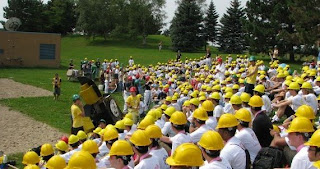
Orientation Week is a longstanding tradition of the University of Waterloo. Although the events have changed drastically over the years, the same spirit of excitement and pride in our school and faculties can be seen today.
Take Engineering Orientation, for example:
Over a period of two days, the incoming students last year were invited to participate in such ridiculous events as sliding down an enormous homemade "Slip 'n Slide" to splash into a big puddle at the bottom, grasping onto their very muddy leaders to guide them safely over a 20-foot long mud pit, working together to form a human conveyor belt to transport their leaders across a lawn and into a kiddie pool, and forming teams to transform a junkyard mess into carts and catapults. And that's not even the half of it!

All joking aside, the greatest quote that I have ever heard regarding Waterloo's Orientation Week is, "The purpose of Orientation Week is not to have fun". Although it may sound a little harsh at first, the meaning behind it is that Orientation Week's true purpose is to make all incoming students feel welcome. It's a chance to make new friends, get acquainted with your school, and get to know a little more about your faculty and program... all the fun is just a bonus.
The planning and excitement for this year's Orientation Week is well underway, and I can safely say that Engineering's Orientation Week will be an event not to be missed. With any luck, I'll see you there! :)
We can! We can! Fix anything with gears!
Ah, the echo of Orientation Week.. it's something that you never forget. Being a head leader for Software Engineering's 2009 Orientation Week makes it something that I never want to forget. Let me take you back to last year:

Orientation Week is a longstanding tradition of the University of Waterloo. Although the events have changed drastically over the years, the same spirit of excitement and pride in our school and faculties can be seen today.
Take Engineering Orientation, for example:
Over a period of two days, the incoming students last year were invited to participate in such ridiculous events as sliding down an enormous homemade "Slip 'n Slide" to splash into a big puddle at the bottom, grasping onto their very muddy leaders to guide them safely over a 20-foot long mud pit, working together to form a human conveyor belt to transport their leaders across a lawn and into a kiddie pool, and forming teams to transform a junkyard mess into carts and catapults. And that's not even the half of it!

All joking aside, the greatest quote that I have ever heard regarding Waterloo's Orientation Week is, "The purpose of Orientation Week is not to have fun". Although it may sound a little harsh at first, the meaning behind it is that Orientation Week's true purpose is to make all incoming students feel welcome. It's a chance to make new friends, get acquainted with your school, and get to know a little more about your faculty and program... all the fun is just a bonus.
The planning and excitement for this year's Orientation Week is well underway, and I can safely say that Engineering's Orientation Week will be an event not to be missed. With any luck, I'll see you there! :)
Subscribe to:
Posts (Atom)